You might think you know me, but do you really?
Someone mentioned The Weepies yesterday and it got me to put on some of their stuff this morning. They were so good and seeing them in a super small theater years ago was one of my all time favorite shows (and I have seen a lot of shows…)
I have had a difficult couple of days and this particular song hit me pretty profoundly, and it inspired to write. I am feeling connected pretty deeply to this song right now, and it has stirred up a lifelong “thing” I have wrestled with.
In most any area of life I find the grouping and generalization of people and things difficult and disingenuous. It often leads to assumptions about people’s identity that are preconceived, ignoring the millions of other factors that are a part of that person, many that may even be in contradiction with each other.
I understand the usefulness of some functional classification. If a bookstore put out all of their books in alphabetical order by title, it would confusing and inefficient. They have to organize them somehow.
Although even that level of categorization can be subjective, is the movie Alien a horror movie or a science fiction movie? Maybe it’s a horror movie in a science fiction setting, or maybe it’s a science fiction movie with a horror theme? Would where it is presented change the likelihood of someone watching it or give them a notion of what sort of movie it is without first seeing it?
One of my least favorite questions a person can ask me is “What kind of music do you like?” because I have absolutely no way to answer that, at least briefly and coherently. I like this but I also like this and I really like this but only this part and I don’t like this except for maybe this. I guess most would say I like this but I really only like this type of that….
It’s an impossible question because if I don’t clarify and make all the sub points and distinctions, I feel they are likely to make assumptions about me that are incorrect, or certainly incomplete.
Back when ripping CDs to MP3 was a thing, it was important to be sure to properly tag them. Tagging included the name of the song, the artist, the album it came from, maybe release year, and you could go in to details like composer and such.
To make the process of tagging and organizing files easier and more consistent one would connect to CDDB and retrieve the information that another user had already submitted so that you wouldn’t need to do it manually. It was a great service and I gladly used it to make my cataloging and tagging easier.
This was sort of a defining time for me in the formation of my thoughts about categorization and assumption though. You see, one of the data points people would enter when they were the first to submit the info would be Genre, and typically one would choose this at the album or even artist level, and it would apply it to all of the tracks on the disc.
I always had a problem with that. A really big problem.
The dictionary defines genre as a category of artistic, musical, or literary composition characterized by a particular style, form, or content.
On the surface that makes sense I guess and with huge broad strokes one might be able to listen to a song and say “that sounds like Rock & Roll” because it has a distorted guitar or something,” but who defined these characteristics? Does everyone agree on them? Do we vote on them? Are they the same everywhere? Do they ever change?
People often call Neil Young the father of grunge, but they didn’t call it grunge when he was making it. When they did start calling music Grunge in the 1980s does that mean that Neil Young’s music was incorrectly classified prior to that. Do we change the genre of the music he made in the past? If Neil Young was “grunge” before grunge even existed, what does that say about the whole classification system?
I recently had started a project where I was assigned an album a day that “I must listen to before I die” and I struggled with this during that project. I vowed to listen to at least the first minute of every song off of the album I was assigned so I felt I could be open to it without a preconceived opinion. I found that I generally didn’t appreciate the music they categorized in broad terms as hip-hop and rap but it wasn’t absolute. In the genre they called R&B I didn’t care for some of the artists but the Marvin Gaye on the list was fantastic. I couldn’t have loved the “Soul” of Otis Redding more than I did, and while I am normally not a fan of what is traditionally called “Country” I couldn’t have gotten enough of Johnny Cash’s Folsom Prison.
In my opinion the whole paradigm of applying genre to music is just inherently flawed, especially utilized the way that it was used in the tagging era, but everywhere else too. Even if we can agree on a general musical style and apply it, it is inherently limiting and restrictive and in actual usage so grossly and inaccurately misapplied that it really has no usable function.
I think the best way I can explain my thinking here is to give some examples, we’ll start with Lyle Lovett.
The wikipedia article on Lyle Lovett describes him as an American country singer-songwriter. I think Lyle certainly incorporates aspects of what we might traditionally call country music in some of his songs, especially early in his career. However, I think it is woefully inaccurate to call him a country music artist. He routinely incorporates other styles in to his songs, traditional bluegrass, gospel, blues, big band (or large band in his specific case…) rock, swing etc.. The wiki article does indicate he is considered alternative country. Alternative to what? Isn’t anything not country an alternative to country?
The problem I saw with the actual implementation of these genres in the tagging scenario is that Lyle Lovett would get tagged as a country artist, which would tag all his albums as country albums, and then all his songs as country songs. It was presumptive, assumptive, unverified and inaccurate and just lazy, which made the information completely untrustworthy and useless. How many people have chosen not to listen to Lyle Lovett because he is a “country artist” and they don’t like “country music” – if they only knew what they were missing!
There may have been a lone individual who would individually tag every album and song with the predominant musical style of each song – but honestly I never saw it, not even once.
So what did I do to try and remedy my problem with how genre was being (mis)applied? I would go in to edit mode and clear or empty the genre field of every album and every song of every file I ripped. I disabled the genre field in my cataloging software altogether. I just refused to use the system at all, and in reality I had no use for it anyway. My playlists and mixes are all over the fucking place, and I love that about them.
I haven’t even gotten in to sub-genres and mixed genres. Southern rock for example is typically defined as a a hybrid of blues, country, gospel, soul, and sometimes jazz in a predominantly rock format. I am not sure I even know what that means. Just how much jazz can a band like The Allman Brothers (who get lumped in to that meaningless sub-genre) incorporate in to a “rock” song before it ceases to be a rock song, and would it then be called southern jazz?
When Warren Haynes and Allen Woody formed Gov’t Mule during their stint in The Allman Brothers they were called a Southern Rock band. Why? They wanted to bring back the heavier “rock” power trio sound but I guess they were from the south and spun off from a southern rock band, so they must also be a southern rock band.
They are also considered a jam band, a term that no one really seems to be able to agree on a definition of. Is it the improvisation? Is it the long song structure? Is it the fandom? The musical style or mix of styles? Collectively there is a community built around bands that have been assigned the moniker but how one becomes a jam band is a mystery to me.
Gregg Allman once said that rather than being a jam band, The Allman Brothers are “a band that jams”. – I’ll go with that!
If we can’t even accurately categorize or agree on the classification of music, why do we think we can categorize people?
By birth year I would be considered Gen X, and if used in functional demographic terms to explain the general conditions of the world and events that occurred during my life phases, those are factual statements. You can give statistics about divorce rates or the AIDS epidemic or the rise of personal computing and all of those things would be true about me.
However, it is also stated that:
Gen X is the MTV generation because they embraced the network and the video format launched in 1981. They are apathetic, it is the slacker generation, but they are independent and resourceful. They prefer face to face and phone communication over email. They are the generation of grunge, rap, and hip-hop.
Even if any of this is statistically accurate, one of our greatest failures is using these categorizations to assume the ‘default’ characteristics of someone and assigning those traits to someone erroneously. The way I feel I differ from the above generalizations are many, and often quite profoundly.
By general political beliefs most would call me liberal, very liberal. I abhor when I hear things like “liberals are…” or even “conservatives are” though, because, again, they don’t take in to account the millions of stages of gray in between what many seem to consider a black and white distinction.
I believe that this is becoming increasingly more common, and more dangerous. I have been presented in just the last few days some abhorrent generalizations about the “radical left” or the “dangerous right”, or “immigrants are…” or “Muslims are…” or “Catholics are….” or “Millionaires are…” or “transgender people are…” and this is going well beyond any functional classification, these generalizations are being used to presume the identity of the people in these groups, as if we can assume the fundamental nature of everyone who is in such a group. These gross generalizations lead to distrust, anger, blaming and violence. Extreme violence and I just see it getting more and more dangerous every day.
I try really hard to avoid such classifications, I may not always be successful but I deeply try to focus on specific actions by specific people and not generalizations. It isn’t fair to anyone to not give them the agency and autonomy of being a unique person.
I am a deeply complex person with a completely different set of beliefs, experiences, thoughts, opinions, knowledge, bias, emotional and physical maturity, physical characteristics, mental capacity, family and societal influence and many other distinctive differences than anyone else. I am 100% uniquely me.
So are you.
So is your neighbor, and the guy who delivers your pizza, and that guy on that tv show you like, and the president, and all the people out there you have had no personal interaction with.
And yet we seemingly do everything we can to compartmentalize and categorize people in to boxes, and give them these overriding definitions of who they are and what they believe, ignoring or even demonizing any differences, or inventing differences that aren’t even there.
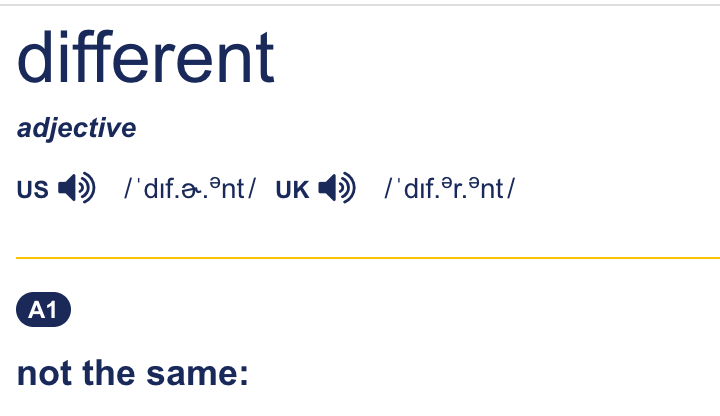
I am fucking different.
Be fucking different.


Leave a Reply to Scott B (he/him) Cancel reply