I want to take a break from music and my usual inanity to get serious and share something that is really important to me.
Here are a few alarming facts about CRC from the fine people at Fight CRC:
- One in 23 men and 1 in 25 women will be diagnosed with CRC in their lifetime.
- By 2030, colorectal cancer is projected to be the No. 1 cancer killer for people age 20 to 49.
- Those with a family history of CRC are at a higher risk and need to be screened earlier than 45.
- There are more than 1.5 million CRC survivors in the United States.
- CRC is underfunded by the federal government. Of the top five cancer killers, CRC is the only one that doesn’t have its own research program and dedicated funding stream in the Department of Defense Congressionally Directed Medical Research Program. Instead CRC must compete for limited funding with about a dozen other cancers.
So this is personal for me – I was diagnosed with Stage II Colon Cancer in October 2018 during my 1st colonoscopy at age 50. I had no symptoms or family history. The GI who did my procedure called my wife in to the room and while I was still waking up, he told us that they had found a mass during the exam. A week later (A WEEK) the biopsy reults confirmed that it was cancer, My wife and I, while not ready for any of this, prepared for the road ahead. We made lists of questions, talked to nurse friends, and tried to educate ourselves without overdoing the research on the Internet.
I was scheduled for a December laproscopy but in November I had a ruptured diverticulitis that forced an emergency colectomy surgery and colostomy. They removed the tumor and after a few days in the hospital I went home to continue my recovery.
We worked with my Oncologist to develop a treatment plan – I would undergo 12 chemotherapy infusions over 6 months to help prevent recurrence, a process I finished in August 2019. The infusions lasted hours and were done through a newly inserted port in my chest (yay – more surgery!) Gina was amazing – she sat next to me each and every moment I was in that chair to keep me company! The nurses at the infusion center were great and helped me feel safe and comfortable. My hair thinned, my taste buds faded and I routinely fought nausea and fatigue. By the time I felt like I recovered from one session, it was time to do it again.
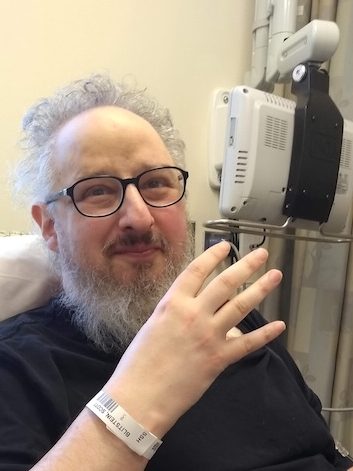
My particular chemo was unique in that after the infusion at the hospital, I had to continue the process at home over the next two days by wearing a bag with a special pump. They gave me a Biohazard clean up kit to use should the pump ever leak. I always thought it was interesting that the stuff they pumped so readily in to my body every two weeks was so dangerous that I couldn’t touch or handle it.
After I completed the chemo, my first attempt at reversal surgery in October 2019 was unsuccessful. The surgeon repaired my colon and closed the colostomy but I had an ileostomy placed so that things would have a chance to heal before another reversal attempt would occur. I had a second reversal surgery in March 2020, just days before the Covid shutdowns, which was successful this time.
The covid epidemic and shutdowns made my transition to ‘normal’ anything but normal as we all adjusted to new routines and increased home time. I was still immuno-compromised so I was extra careful to stay safe and avoid potentially dangerous situations.
Overall it was about 19 months from diagnosis, through treatment, until recovery from the reversal surgery. Gina and I have talked a lot about how we got through that time. It was mostly sure will and determination, but it also was combined with our plan to just focus on “ok – what is the next thing?” to avoid becoming overwhelmed by the enormity of everything that was happening. We would go from blood work, to an infusion, to more blood work, to a doctor appointment, to a meeting at the support center, and on and on. By keeping our focus limited, we could check these things off as we did them until it eventually was complete.
It is now 5 years later and while I still struggle with the residual effects of chemo such as neuropathy in my feet, my regularly scheduled tests and scans continue to be normal.
I was lucky. My cancer had not spread out of my colon to lymph nodes or other organs when it was discovered. But that’s only because I got screened when I was supposed to. Had I delayed or skipped that colonoscopy things could have been very different.
So if you take away any one thing after all of the above, it is to talk to your doctor about any potential symptoms you may have or any family history or other risk factors and find out when you should start your own screening.
And then go and have the procedure done when you are supposed to, and do it again when you are due, and then again, and never skip it. It is painless and sure, the prep isn’t necessarily pleasant, but neither is having a colostomy or getting chemotherapy.
CRC is preventable with screening and affordable take-home options. It is estimated that 68% of deaths from CRC could be prevented with screening. All adults 45 and older should be screened (unless you have additional risk factors.)
To learn more about Colorectal Cancer I recommend a visit to FIGHTCRC.ORG or start with this screening quiz:

Your thoughts?